
Chain-Link Fencing
Perimeter Fencing That Holds Without Maintenance
Chain-link fencing in Lexington for residential and commercial properties requiring durable boundary definition or pet containment
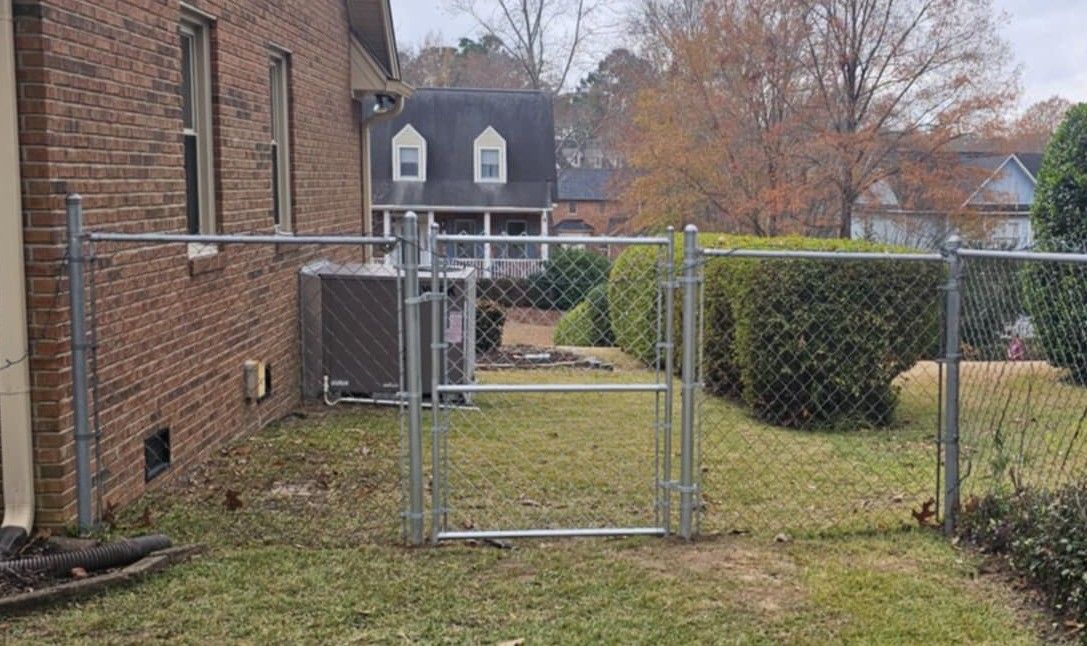
Chain-link fence performs a specific job with a specific set of trade-offs: high structural durability, low maintenance demand, and clear boundary definition, without the privacy that wood or vinyl panels provide. RHB Construction installs chain-link fencing in Lexington for residential and commercial properties where containing pets, securing a perimeter, or defining property boundaries is the functional requirement. Property owners who choose chain-link are typically working with larger lot sizes, commercial parcels, or side and rear yard applications where visibility through the fence is not a concern and the priority is a fence that stays upright and functional for decades without intervention.
Installation begins with post layout and setting. Line posts and terminal posts—corners, ends, and gate openings—are set in concrete at different depths and footing diameters, because terminal posts carry tension load from the fabric while line posts carry only lateral load. Getting that distinction right in the concrete work determines whether the fence holds tension along its full run or begins to pull inward at the corners and ends as the fabric is stretched. Fabric is then attached and tensioned using tension bars threaded through the end links, connected to the terminal posts via tension bands—a process that, when done correctly, produces a fence face that does not ripple or sag at mid-span.
Set up a property review to walk the proposed fence line, identify terminal post locations, and confirm gate placement before installation begins..
The Difference Between Correctly Tensioned and Undertensioned Chain-Link
Chain-link fabric that is not properly tensioned during installation produces a fence that looks finished from a distance but fails its functional purpose up close. Undertensioned fabric sags visibly at mid-span between posts, creates gaps at the bottom of the fence line that allow small animals to push through, and rattles in wind—none of which is a hardware failure, all of which traces back to how the fabric was stretched and connected during installation. Proper tensioning requires pulling the fabric tight enough that the diamond pattern is uniform across the full run, then securing it before releasing the stretching equipment.
A properly installed chain-link fence is immediately distinguishable from an undertensioned one: the fabric face is uniformly taut with no visible sag between posts, the bottom of the fence sits consistently close to grade along its full run, and the fence does not move laterally when pushed. RHB Construction sets bottom tension wire or a bottom rail on pet containment applications to eliminate the ground-level gap that chain-link fabric naturally tends to leave when the grade is not perfectly flat.
Mesh gauge and coating type are the two material decisions that most affect how a chain-link fence performs over its service life. Heavier gauge fabric—nine gauge rather than eleven and a half—resists deformation from impact and maintains tension longer, which matters most on commercial properties or runs where the fence is likely to be contacted by equipment or vehicles. Galvanized coating protects the wire from surface oxidation, while vinyl-coated options in black or green reduce the visual prominence of the fence against landscaping backgrounds.
Answers About How Chain-Link Is Installed
These questions address the installation decisions and sequencing details that affect how a chain-link fence performs over its service life—from post setting through fabric tensioning and finishing.
- How does the installation sequence for chain-link differ from wood fence installation? Posts are set and concrete is allowed to cure fully before any fabric is attached—pulling tension against posts that have not cured moves them before the concrete sets, which misaligns the fence line and compromises terminal post holding strength.
- What makes terminal posts structurally different from line posts in a chain-link installation? Terminal posts receive the full tension load of the stretched fabric plus the compression from top rail ends, so they are set deeper in larger-diameter footings and are specified at a heavier pipe gauge than the line posts that carry only lateral wind and contact load.
- Why does mesh gauge selection matter more on commercial properties than residential ones? Commercial perimeters face a higher probability of vehicle contact, equipment impact, and repeated physical stress—lighter gauge fabric deforms permanently under those loads, which compromises the fence line and requires panel replacement rather than simple repair.
- How does Lexington's mix of residential subdivisions and commercial parcels affect how chain-link projects are typically scoped? Residential lot applications often involve shorter perimeter runs with multiple gate openings, which increases the proportion of terminal post work relative to line post work—the most structurally demanding portion of the installation—compared to longer commercial perimeter runs with fewer interruptions.
- What should you check along a finished chain-link fence to confirm the fabric was installed correctly? The diamond pattern in the mesh should be uniform across the entire run with no visible elongation or compression at any section, the fabric should not move more than a half-inch when pushed laterally at mid-span, and the bottom knuckles should sit at a consistent height above grade along the full length.
RHB Construction also installs chain-link fencing in Camden and Columbia. To discuss post layout, mesh specifications, and gate placement for your property, reach out to RHB Construction to begin with a fence line review.